

Here in the Blue Ridge Mountains of Appalachia everyone knows the saying, “You can tell when times are hard. The gardens get bigger.” Although dependence on home-grown food is not as common as it was even a decade ago, anyone who lives here can see other clear signs of economic distress by what people are selling: firewood from pickup trucks in shopping center parking lots; boats, campers, and motor homes in driveways with for-sale signs; and finally, cars and trucks marked for sale. First the luxury items go up for sale, then the necessities.
In rural and small-town America, community development means something different than in urban settings. Urban community development corporations primarily work to revitalize small, physically decaying neighborhoods with bricks, mortar, and finance. They focus on fixing infrastructure, developing affordable housing, and lending to small businesses. When they focus on people, it’s often to give them specific training for jobs that exist, if not in their neighborhoods, then somewhere in their metropolitan region.
These approaches are not so useful here in the mountains. Rural areas are not just physically dispersed and isolated; they also have had different patterns of economic development. Central Appalachia is representative: It has experienced waves of development from outside that industrialized without urbanizing and didn’t create an indigenous middle class of small business entrepreneurs. The economy focused on exploiting natural resources, from timber to coal to textiles and back to coal. Profits flowed out of the mountains.
In the global economy, many rural communities have shrunk from economic centers to mere ghosts of their former selves. Places like Dungannon and Ivanhoe, Virginia, were once thriving centers for commerce, education, and entertainment; now they are bedroom communities for people with long commutes. First the main employer – National Carbide and New Jersey Zinc in Ivanhoe, the rail yard in Dungannon – closes. Then local businesses start to fail. The branch bank closes. Eventually, schools get consolidated and children are bused across the county. Finally, the churches close or only have a preacher once a month. Folks compete with each other for the few scarce jobs, not just in the community, but in the region.
Even large immobile employers can be a mixed blessing. Universities are often employment centers for a rural region, but they also create a strikingly two-tiered economy. Most jobs offered to indigenous folks are low-paying, even when they require many skills, like the wide array of computer programs secretaries must know. At the same time, universities attract a wealth of educated and skilled “outlanders” who flood local entrepreneurial efforts. In the New River Valley in southwestern Virginia, where I work, the New River Valley Competitiveness Center and the Virginia Tech Corporate Research Center have been creating local high-end jobs – but those jobs are dominated by faculty, family of faculty, and graduate students from Virginia Tech and Radford University. Even for low-skilled contingency work, local people compete with over 36,000 students.
The traditional responses from county planners and economic development experts to these problems are to seek new large employers or provide skills training to displaced workers. Neither of these approaches will be successful in the long term.
Bringing in new corporate giants repeats the cycle of outside control, with ever lower-paying and less stable jobs. Corporations coming to the mountains are looking for the same things they look for in less-developed countries: low- or no-cost land and buildings; infrastructure provided by local government; low taxes or tax rebates; few if any health, safety, or environmental constraints; non-union workers with few employment options; and governments willing to provide the above. Existing power structures in rural areas are often more vested in selling the area to corporations than in protecting the interests of low-end workers.
Retraining or advanced degrees won’t help either, if the only jobs available are low-wage retail positions in malls and fast-food restaurants. As one mountain song says, “I’ve been trained as a heavy equipment operator. Now I’m waiting for the heavy equipment.” Over 15 years ago, AT&T left Pulaski County, Virginia, for the maquiladoras of Mexico. Nearly 2000 local workers were thrown out of work. AT&T relocated 18 of its managers, buying their quarter- to half-million dollar homes. The other workers got an educational package. Many got degrees, but 15 years later most are still working low-end service jobs. The land around the AT&T place has been turned into a golf course. You don’t need an advanced degree to ride a mower. They couldn’t leave for jobs in the city: with economic prospects what they were, no one would buy their homes.
Poorly funded local entrepreneurial efforts that don’t address larger power dynamics are not likely to succeed either. In Radford, Pulaski, and Christianburg, Virginia, the main streets are lined with empty storefronts, while local consumers flock to ever-expanding regional supercenters. In Dungannon, two attempts at a community-run sewing factory failed after management challenges and tougher than expected competition from multinationals. Helen Lewis, a long-time community development worker in Central Appalachia, calls this the “steel ceiling” of rural community development. Existing economic opportunities are oppressive, but indigenous entrepreneurs don’t have the capacity to compete with them.
**
In the face of such conditions, community development in Central Appalachia has come to mean indigenous control, first and foremost. It means neighbors working with neighbors to solve community problems as defined by the community, identifying local resources, and working toward self-sufficiency. There are three parts to this work: 1) identifying and nurturing “new leaders,” most often women who are not part of either the existing governing structure or the more covert power structure of the “better” families, and who are often the heart of a broader community, and can authentically speak for a wider spectrum of people; 2) getting the community to identify its problems as community concerns, not individual problems; and 3) helping communities recognize their capacity to analyze and solve their own problems, to move from passive residents to active citizens.
Developing new leaders without imposing outside agendas is a fine art. Joyce Dukes, former director of the Southern Appalachian Leadership Training Institute (SALT), says you need “the ability to honor people where they are and treat them as who they could be.” It also involves giving people what they think they need, not what you think they need, even if you are right. Being able to do this is more an attitude than a technique.
Over the past 40 years a network of women, many not from the mountains, has been doing this kind of work in Central Appalachia as a form of ministry. Many of them have been involved with the Highlander Research and Education Center, founded by Myles Horton, and its spin-off, SALT. Established in 1932 as a popular education center for labor organizing, Highlander has long been in the forefront of developing ways to support indigenous leadership in the rural south.
Anne Leibig and Helen Lewis worked with Horton and brought some of his ideas to Dungannon, Virginia, in their work with a network of women called FOCIS (Federation of Communities in Service). Leibig and Lewis helped found an education center and intentional community, the River Farm, outside of Dungannon, and Leibig became town manager. Through the women’s club she helped the citizens form the Dungannon Development Commission. But although Leibig and Lewis actively supported bricks-and-mortar development in Dungannon – including a clinic and a water system – they also developed new leaders to challenge the power structure.
They supported people who made good suggestions and then challenged them to take over and make their suggestions reality. Local leaders repeatedly say that they thought themselves incapable before Leibig’s encouragement helped them see themselves as initiators. One leader said people often went from thinking they couldn’t do something to leading the effort without knowing how it happened.
**
One of the most potent forces for bringing a community together is sharing stories with each other. Rural community development often places a high priority both on formal storytelling – such as oral history and community mapping projects – and on cultural activities that provide the space for informal storytelling, brainstorming, and reinforcing shared identities.
Storytelling allows a community to shift from thinking of its problems as individualistic to realizing how they fit together into collective patterns. Maxine Waller founded the Ivanhoe Civic League when the Union Carbide plant closed. At the time she wanted some other large company to take its place. “I wanted GM and I wanted GE and I wanted IBM,” she recalls.
It was an oral history project that shifted Waller’s focus. In the late 1980s, Helen Lewis worked with local people in Ivanhoe to gather and transcribe stories that were ultimately published in two volumes: Remembering Our Past, Sharing Our Future and Telling Our Stories, Sharing Our Lives. Through this process, people shared stories about what it meant when the school closed or the last business in town burned down. They shared stories about looking for work. The old timers taught the younger ones about the “heyday” of Ivanhoe, which once had a theater, a hotel, and an “opera house.” As they laid these stories side-by-side, they came to see that what they felt as individual losses – lost jobs, lost opportunities for education, family members lost to out-migration – were in fact community problems. Waller began to realize that even if new large employers came, it would be as it had been before: the corporations would have all the power and could leave when it suited them.
The people of Ivanhoe also learned that they had resources and capacity for change, both individual and collective: their own understanding of the region; their networks of information and people; their political clout as a group; their ability to gain information, and to organize and present it effectively; and their ability to lead and organize themselves.
“Storytelling can change communities,” says Carol Kuhre, executive director of Rural Action in Athens, Ohio, gesturing to a mural that resulted from a collective oral history project in two small communities. The project was started when a high school consolidation brought together two towns and schools that had historically been rivals. The oral histories focused on how both towns had coped with a recent flood. A play based on the oral history was performed in front of the mural, which adorns the new school, drawing the communities together, creating a sense of commonality around the floods, and becoming the basis for new inter-community cooperation.
A formal storytelling exercise like an oral history project is also a perfect opportunity to develop new leaders. Local individuals become the collectors of stories, functioning almost as community organizers as they go from home to home, person to person. Once the stories are collected, others can take leadership on a number of tasks, from transcribing, painting a mural, or publishing.
**
After Ivanhoe’s oral history project, Waller refocused the efforts of the Civic League on quality-of-life issues. The League developed an alternative break program for college students who come to Ivanhoe during their spring or summer break and contribute to community projects. The students also learn about community development and life in rural Appalachia through economic, cultural, and historical programs. Along the way, not only has Waller been growing as a leader, but many other community members have become organizers in their own right. There has been no economic miracle in Ivanhoe, but it does have a vital community life.
Informal cultural work also cannot be overlooked: it can include cooking and eating together; celebrating success, holidays, or special events; sharing traditional music, crafts, or storytelling; or creating interactive theater, murals, or satirical giant puppets. In my work in an Emergency Assistance Pilot Program in Floyd County, Virginia, people brainstormed projects at the Christmas dinner and year-end celebration, and came up with six projects within an hour, including a system for checking on elderly women without telephones, delivering firewood to the elderly, and a food delivery service for those without transportation. Things like this often happen when folks are feeling good about what they have accomplished, and informal settings can generate involvement that formal meetings would not. But it cannot be “fetched on” cultural work that is the product of an academic theory. It must speak to people’s lived lives and be indigenous to the region. “You have to start with what people know, what touches them, what eases their hearts,” says Candie Carawan of Highlander.
Finally, education – especially economic literacy – is a powerful tool for community development because it enables people to locate themselves and their communities in the broader scheme of things. A community-based education program that combined economic literacy with GED and community college degree work began to train new leaders in Dungannon. This economic literacy training, combined with the oral history project, GED classes, and cultural events, helped Maxine Waller see beyond smokestack chasing.
Beans and Rice, a community development corporation I founded in the New River Valley, focuses on leadership development, especially among children in low-income housing projects. Such projects are particularly challenging places in which to work on indigenous control. Families move constantly, so there is no oral history to capture. Adults who can do so, invest themselves in getting up and out, and are not available to lead. Those who are available rarely have the motivation. A sense of hopelessness hangs like a cloud over the complexes.
 |
|
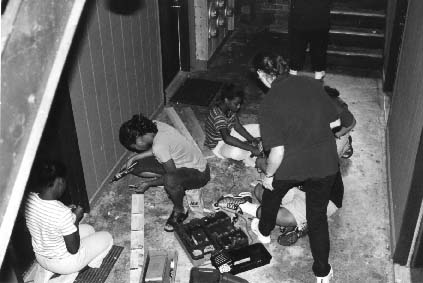
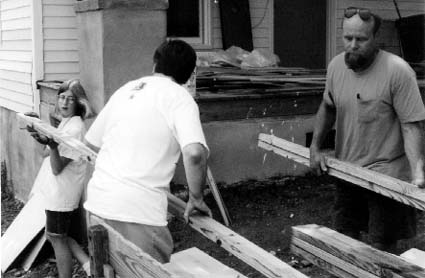
Beans and Rice, Inc. does economic and entrepreneurial development training with youth. Here, participants build coat racks. Photo Courtesy of Beans and Rice
|
Beans and Rice is attempting to address this by working with the youth. We recognize that we may simply need to “be” with the adults, through programs like our weekly communal meal, which are important for establishing the trust of the community. But we believe we can actually shift the lives of the youth, encouraging them to be social and economic entrepreneurs, leaders who think of the good of their community as essential.
Our new Youth Leadership Program involves economic literacy and entrepreneurial development training. First we focus on personal finances, and then on the global economy and how it affects the local economy. Next we will combine site visits to successful community-based businesses with small, low-risk entrepreneurial efforts that the youth design and implement. Little by little, the youth will take more responsibility for their own economic education, eventually developing and leading their own workshops. We are also seeking to fund Individual Development Accounts for the youth, and to start a not-for-profit business that focuses on the student population as consumers while at the same time building the capacity and leadership skills of its workers.
In all this work, the bottom line is that it has to be what the community at large – not key decision makers or power brokers – wants and believes it needs. As Maxine Waller says, “If it is good or if it’s bad, if it’s a huge failure or if it is a huge success, the people of Ivanhoe have to be in charge.”
About the Author

Comments