

The second week of October 2001 was a busy one for Nobel Neighbors, a community organizing group in Chicago’s West Humboldt Park neighborhood. It organized 30 residents to attend a rally against predatory lending, met with HUD to discuss the management of abandoned housing in the area, and worked on beautification projects, social services, violence prevention programs, and mapping the community’s assets. The organization also had to attend to its limited but important role in a co-op development being carried out by two other nonprofits across the street from Nobel’s offices. Not to mention, staff and board were busy trying to raise the funding to keep the office running and meet payroll.
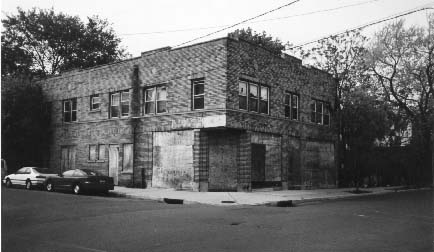
But that wasn’t all. To cap off this hectic week, the Chicago Community Loan Fund made a site visit to an abandoned house (shown below) on Potomac Street that Nobel Neighbors wanted to purchase, rehab, and sell to a local family. The Loan Fund staff were impressed with the project, and gave the group about a week to put together a final application.
With all it had on its plate, why was Nobel Neighbors trying to get into housing development? Nobel Neighbors has addressed housing issues in its organizing work. It organized successfully for a $380 million CRA commitment from Bank One and worked with HUD and FHA on the problems of abandoned buildings and shoddy practices by FHA lenders. In 1995 it got lenders to sell three vacant buildings to another nonprofit for development as affordable housing.
A successful development project that is integrated with an organizing group’s other strengths can be a boon for both neighborhood and group. Actually developing housing is a much different prospect from organizing around it, however. A development project that strains an organization’s capacity or siphons energy from its original focus can be worse than nothing at all. And a few houses cannot begin to address the need. In planning for this project, Nobel Neighbors has had to answer many tough questions; its process can provide some lessons to groups in similar situations.
West Humboldt Park is among Chicago’s poorest neighborhoods, with a poverty rate topping 60 percent. Most of the area’s housing stock is over 75 years old, in bad shape, and overcrowded. The handful of affordable housing developments built in the past 20 to 30 years have not come close to meeting the need. Recently, upper-income professionals have started to migrate to the area from more expensive neighborhoods, threatening to further exacerbate the shortage of affordable housing.
But there is already an established CDC with a good track record – Bickerdike Redevelopment – that had expanded its service area two years ago to include all of West Humboldt Park. Nobel Neighbors was a partner in Bickerdike’s first effort – the 16-unit co-op across from Nobel Neighbors’ office – and Bickerdike welcomes their involvement in future projects. “We wouldn’t want to take on a project like that without [Nobel Neighbors’] participation. We see them as the group with the legitimate community base in that area,” Bickerdike Executive Director Joy Aruguete says.
Nonetheless, Nobel still feels the need to strike out on its own. “Leaving it to others seems just too much like what’s happened to this community all along,” Jim Lundeen, chair of Nobel’s Housing Committee, says. “And as for inviting other developers in – even the well-meaning ones already have their engine running when they get here. Right or wrong, we’ve had this sense that we need to be the developer ourselves for the project to be truly grassroots-controlled.”
Nobel Neighbors also has several organizational goals in mind. The first is having concrete evidence of Nobel’s impact. “We’ve organized for better police services, but once the vigils and marches are over it’s not like most residents can see the role we played in making the community safer,” Lundeen says. “Even with some of our tangible victories – like getting the banks to turn over those buildings – the community doesn’t see our name on them.”
Along with attracting more members (and more funding), Nobel Neighbors also hopes to increase its credibility and gain a more respected position in the community. Group leaders are still looking at partnerships down the road, but want to have one building they can point to as their own accomplishment. That way, “potential partners won’t be able to treat us like neophytes who have never suffered through a development project,” says Lundeen.
Many small community groups share these good intentions and legitimate aspirations when entering into housing development, but struggle with the new direction and its completely different set of skills and requirements. Thanks to a self-assessment process supported by the Loan Fund, Nobel Neighbors has taken the time to think through many of the implications of developing this house. “Our eyes were certainly opened by this assessment process in terms of the work and issues we’ll be facing,” says Executive Director Dean Morris. “We were encouraged about the opportunities for integrating this project into our other work, so long as we plan ahead.”
The first question Nobel had to tackle was whether the project fit with the organization’s vision. “What we’re about is helping create a healthy community. That means lots of education and involvement, a mix of people economically and racially, good city services, schools for our kids,” explains Thelma Lambert, Nobel Neighbor’s vice president and a long-time community resident. “This house is a good idea, but if we do the house and don’t make progress on the healthy community, we won’t be better off than we are today.”
Redeveloping the abandoned HUD house on Potomac seems to be a good fit with Nobel Neighbors’ vision. Area residents see the house as a hot spot for drug dealing and gang activity. It’s around the corner from a community garden the group organized, and just a block from the Alfred Nobel elementary school (after which Nobel Neighbors is named). Increasing homeownership among local lower-income families is an important part of stabilizing the community.
A more complicated question is how actually developing the project will fit in with the group’s other initiatives. Small grassroots groups often leave behind their important work in community building and organizing when they take on housing development projects. The key is to make sure that the new effort builds on and supports the group’s strengths.
Since its founding in 1985, Nobel Neighbors has suffered the ups and downs of funding and staff turnover endemic to small community organizations, but it has nonetheless established itself as a credible, aggressive, important organization operated by and for the area’s residents. Its success grew from its skills at bringing local residents and institutions together to address area problems, and it has come to be known as a group that brings together people of different races and backgrounds. How might housing development complement these strengths?
That was not something the group had started out thinking about, except in general terms. But since the question was raised, they are considering how to make this small rehab project part of a larger campaign. The city is planning to expand a local park, displacing 40 local residents along the way. Nobel Neighbors envisions organizing the community at large to influence physical and program development plans for the park, organizing the affected residents to demand just and appropriate compensation, providing services to displaced residents to help them relocate in the community, and helping create new or rehabilitated housing for some of those displaced – including, perhaps, the house on Potomac.
Even when development and organizing work well together in terms of vision and strategy, however, they are still very different activities. Many community activists warn that once a group takes on the titles of “developer” and “landlord” it can no longer be an effective agent for community empowerment. At the very least, expanding into housing development can invite values clashes and dilemmas. A group like Nobel Neighbors must make plans for these and set boundaries about what it will and will not do – ahead of time.
Keeping new staff and consultants, whose expertise lies primarily in development, focused on the organization’s larger mission can be a big challenge, for example. Vince Thomas, the retired executive director of the community action agency Project Now in Rock Island, Illinois, urges groups to seek out people who share their organizing values. “There were times when we were battling our own development staff over whether or not there was room for community involvement in project planning,” he says.
Another crucial question is how the group would face – and define – failure. Experienced housing developers run into problems all the time, from cost overruns to projects that never proceed or end up in foreclosure. Sometimes they withstand the difficulties, and sometimes they scale back their ambitions. What makes small, inexperienced, under-capitalized organizing groups think they can do similar projects without experiencing those problems? Such groups typically don’t consider those risks or the potentially devastating effect a failure could have on their organization.
While optimism – some might even say faith – are important components of any social change organizing, risk assessment still needs to be incorporated into a group’s planning First, groups need to define failure. Would it be a failure if the project were completed and sold to someone who is not from the community? What if the rehab work were of lower quality, with fewer exterior improvements to enhance the look of the block? If the only way for the group to break even is to sell the house for more than it originally intended, will the home still go to a lower-income local family? Nobel Neighbors has never before had to decide between satisfying a lender and meeting a community need.
Morris is clear about the group’s priorities. “If it turns out we can’t make it available to a lower-income local family, we won’t do it at all,” he says. “Period.” But what if problems arise when it’s too late to pull out? Groups need to ask themselves if they are comfortable with a picture of their organization after such a failure. What will happen to the group’s capacity, its credibility, and its other good work if this project fails to match the original intentions – or isn’t completed at all? According to Morris, Nobel Neighbors would sooner take a loss on the project than abandon its goals for affordability. But the group also realizes it is ill-equipped to sustain a loss, so it has reinforced its commitment to try to reduce risk ahead of time.
Finally, groups should recognize that development has its own momentum. Project Now developed 100 units of housing over the past decade, and Thomas found it a constant struggle to avoid projects that did not support its other work. “We felt pressure to ‘do deals’ to keep the development fee income coming,” he recalls. “And we had to struggle internally to remain focused on our mission. There were times we turned down projects because they weren’t a good fit – but believe me, that was hard to do.”
The other challenge small groups like Nobel Neighbors have to face is capacity. “We’re short on volunteers, especially those that can fill important roles on the board,” says Lundeen. “That hampers our ability to manage a project like this effectively, but at the same time we’re hoping that a success on this house will help us attract more active volunteers.”
Besides leaders, Nobel Neighbors also needs funding. It struggles to raise sufficient general operating funds, and its financial management systems are minimal. The group expects this project to help in both areas, but in the meantime it needs to make some immediate changes. For the first time, it is managing its cash flow, and it is pursuing more foundation and corporate support. Meanwhile, the Housing Committee is carefully checking out the project’s finances to make sure that it won’t threaten the group’s stability.
Capacity issues like these need to be addressed before a group takes control of a property. “We’ve got a building. Now we just need a loan to fix it up,” is an opening line Calvin Holmes, executive director of the Chicago Community Loan Fund, has heard more often than he cares to remember. “Starting with a site in hand is one of the most common strategic planning mistakes we see,” he says. “Many groups getting into affordable housing development put a lot of pressure on themselves by taking control of a property – sometimes vacant, sometimes occupied – that they don’t have the capacity to carry for the years it might take them to put together a viable development package. And if it turns out during pre-development that this building doesn’t make sense, it’s already too late – they’ve committed too many resources to the site to drop it, even for a good reason.”
Nobel Neighbors has taken the important step of putting off purchase of the property until all the financing is in place and they can be assured of the viability of the project. “We want to avoid taking ownership of the building only to find out we can’t do with it what the community wants,” says Morris.
So the house on Potomac sits quietly for now, boarded up and waiting. Meanwhile, says Lundeen, the project has “brought organizational issues to a head. We’re looking carefully at board development, fundraising, financial
management, and making sure all of our efforts fit well together.” Lambert adds that they’ve come to realize the value of good planning before getting started, and coming up with back-up plans: “Stuff comes up in the process of doing a project like this that wasn’t apparent at the beginning. We need to be prepared for that.”
Expectations are high that this house will get done and will help build the organization. But at the same time a sense of reality has set in. Nobel Neighbors never imagined the project would take so much staff and board time, or require such a major financial commitment. The group’s resources have already been stretched to the limit, while at the same time it has relentlessly pursued an ambitious agenda. The group has postponed any talk of increasing its role in housing development. “We want to try to do this one house well,” Morris says, “and then we’ll see if this is how we should proceed in the future.”
[See also: Ten Things to Consider Before Getting Into Real Estate and Going the Other Way: Adding Organizing to Development]
About the Author

Comments